If you’re someone who owns or operates a website and you’re reading this, I’m going to go out on a limb and say that you’ve never done proper search engine keyword research in your life. In fact, I bet you’ve never even given a second thought to what words people use in search engines, let alone how to determine if people are, in fact, using those phrases. Searching for and choosing the correct keyword phrases comes before everything else when you’re looking to improve incoming traffic from search engines and I’m going to teach you how to do it.

What’s in it for you?
Long story short, making rational decisions about your keywords means more and better traffic from search engines. Instead of adding words that you think people are using, you’ll be adding words that they actually are using. This means you’re not stabbing in the dark with keywords and phrases that might be getting just a handful of searches per month. You’ll also avoid phrases that are more competitive than you could possibly rank for.
Taking it one step further, doing this kind of research puts you in better control of how your site is performing in general and gives you a path forward for the rest of your content. Once you see the words and phrases you’re using with numbers and ranks next to them, you’ll see the whole process differently. Keyword optimization is everywhere – email titles, Tweets, post headlines – and the more familiar you get with this concept, the better you communicate online.
Are you sold yet or what?
Step 1: What’s the point?
This is not a skip-able step because it exists to reduce the amount of work you might have to do. Before you get started searching out potential keywords, make sure you need to do it in the first place. I’m going to assume that you’re not looking to find work for yourself and I think it’s important to figure out what content deserves your time and effort.
Walk through these steps for this type of content (this is critical):
- Informative blog posts or instructional content pages
- Home page
- Product, service, or offering pages
Don’t worry about these steps for this type of content (you have better things to worry about):
- Company announcement or news posts
- Contact page
- Temporary pages (short-term offers, short-term-projects, anything that’s not going to be around for a month or more)
Step 2: Choose the Subject
Once you have decided that the page you’re working on is a good candidate for keyword choosing, now it’s time to figure out what you’re writing about. Once you’ve gotten to this point, I’m going to guess that you already have something in mind but, if not, I’ve written a few posts (here and here) on how to actually choose a subject. What we’re doing here is narrowing down your focus.
For example, let’s say you’re a personal safety advisor (hey, I actually know one of those). You write on a variety of subjects but you recently signed a contract with a social work group and want to write about the safety of social workers. You have a million things to say on the subject but want to make sure that your article is helping your search engine ranking while also educating people. The first thing to do is to come up with a list of possible phrases by brainstorming.
This isn’t just any list, though, this is a list of things that people might be searching to find your article. It’s an effort in putting yourself in someone else’s shoes, specifically the shoes of someone that wants to find you. Think: What words or phrases would I use to find this article? If this wasn’t my field of expertise, what would I tell someone to search? What words or phrases have my clients and customers used in the past to describe this part of what I offer? It might even be worth your time to ask someone outside of your industry what, literally, they would type into a search engine to find you.
Personal safety isn’t my area of expertise so I’m probably a good candidate to find keywords. To find information on the safety of social workers, I might use one of the following phrases:
- social worker safety
- safety of social workers
- keeping social workers safe
- social worker protection
- dangers of social work
- self defense for social workers
That’s a pretty solid list, probably more than we need, actually. This step does two things:
- Solidify what you want to write about … if you can’t come up with a list of 3 or 4 specific ways to describe what you’re writing about, is it necessary to write about it in the first place?
- Gives you a few leads for the research you’re about to do
You probably want to be planning and writing your content at this point. If you have a final draft already, that’s fine but you may need to make a few edits once you choose the actual phrase(s) you want to use. If you haven’t started then now is a good time to get at least your outline together.
Step 3: Keyword Research
This is the step that stops a lot of people in their tracks because (a) it’s time-consuming and (b) it uses tools you might not have been exposed to before. That’s not a good reason to back out now, in fact, this is the most important step because, without it, your work before and after will be wasted.
You’ll be using three applications here: your analytics software (Google Analytics being the most common but any will work. If you don’t have any of this software installed then you should probably get ahold of me), the Google Keyword Tool, and a search engine (I recommend Google not just because I trust their results but because 2/3rds of searches are done in Google and if you’re going to optimize for just one search engine, this is the place to start). Here we go…
Analytics
 What you want to do is to make sure you’re not cannibalizing traffic from another page (you might find a thing or two out about your site in the meantime). You want to pick a phrase that is different enough from what you already rank for so you don’t compete with yourself.
- Find the page that shows you what keywords bring in visitors (in Google Analytics, it’s Traffic Sources > Keywords)
- Search for one word that shows up in all (or most) of your phrases. For the ones above, I’ll use “social.” You’re looking to cut down the number of keywords shown so, if you write about social media a lot then this is not going to work well.
- Once you have a manageable list (less than 50 or so), scan the list for similar phrases that are bringing visitors to another page. If you have a very similar phrase then it’s probably a better idea to strengthen that page rather than write a whole new one. Search engines love refreshed pages that are already ranking so don’t be afraid to repurpose and re-write that entire page using the steps below.
Once you’ve decided that this is a new concept for your site, it’s time to pick a few keywords.
Google Keyword Tool

This is one of those tools online that not enough people use (and one that I’m surprised doesn’t cost any money [hint: they’re trying to sell you AdWords (hint: that might not be such a bad thing)]). This little application will not only tell you if people are searching for the terms you chose, it will also suggest many others that might be better candidate than your original choice. Here’s what to do:
- Go to
- In the “Word or phrase” box, paste the phrases you wrote before (there should be one per line with no extra characters)
- The “Only show ideas closely related to my search terms” check box searches for your exact phrases so leave this unchecked if you’re open to suggestions.
- The “Advanced Options” link will open up a form to allow you to select other regions and languages, filter by devices (like phones), and set lower or upper limits.
- Once you’ve got all the right options entered in, click “Search.” If you left the checkbox in step 3 unchecked, you’re likely to get many different keywords and phrases. The more options you put in the “Word or phrase” box, the more words you’re going to get.
- What you’re looking for in a good keyword phrase is a combination of:
- Low monthly searches – if you’re creating a new page and you don’t already have a lot of “SEO juice” on your site, you’ll definitely want to look below 1000 searches per month, probably also below 500. In fact, I like to pick mine from near the bottom of the list because a #1 ranking for a term with 50 searches is going to send a lot more (and specific) traffic than a #20 ranking for a term with 500 searches.
- How well it relates to what you’re writing about – you want this phrase to be directly related to what you’re writing. Don’t chose a phrase that has good numbers if you’re not specifically writing about it. Set that one aside for your next page or post and find one that fits better.
- Low competition or CPC – competition and CPC (cost per click) are both metrics that tell you about paid search. We’re not doing any paid search here but this is a good indicator of how valuable – both generally and monetarily – that search term is.
- Results page – we’ll look at that with the next tool
- Pick at least 5 different phrases and set them aside. You’re only going to use one or two of them but you want a few to pick from. Also, keep your eye out for good terms that you can use later. I find keyword picking to be a very specific mindset and once I’m there, I don’t want to waste the focus!
Search Engine (Google preferably)
The last step of this process is using a search engine to make sure you’re not going head-to-head with very tough competition. Ranking for a keyword comes from the words you chose, how well they are positioned in your structure, and everyone else who is trying to do the same.
- Search your keyword phrase by itself in a search engine
- Now, just look over the results. The number of results is less important than the sites that are coming up for the same phrase. The kind of sites you don’t want to compete against are (in order)…
- Big names like Wikipedia, About, Amazon, etc
- Government agencies or educational institutions
- A long list of sites that are already optimized for this exact phrase (you see your exact phrase appear in bold in the page titles)
- If a couple results are tough competitors, that’s fine. You might not reach the top result but you could have a chance to reach the first page. Remember, though, that the less total monthly searches that this phrase receives (step 6 under Keyword Tool above), the more important a top 3 ranking is.
- Finally, narrow down your keyword phrases to one (and only one) main phrase and one, maybe two secondary phrases.
You have now done far, far more than most people who decide on the words to use for their site. Congrats! The rest is downhill (especially if you’re using a content management system like WordPress or Drupal).
Step 4: Page Construction
This last step is critical but very easy. These actions will become second nature to you after you’ve done it a few times. Your main keyword phrase needs to go at the beginning (within a word or two, if not right at the beginning) in the following places:
- Page title (this is what appears as the main link to click on the search results page)
- Main site headline (this is the main headline that people see on the page)
- First paragraph of content
- Somewhere in your meta description (this is. if written properly, the text that appears below the main link on a search engine results page)
- “Throughout” your content (just use the phrase naturally, don’t try to put it in every paragraph)
Your secondary keywords can also go in the page title (keep it under 70 characters), in the first paragraph, and throughout but don’t let them get in the way of the primary one. It’s very easy to throw away a potential good ranking for one phrase chasing after 3 or 4 different phrases.
There are other on-page SEO considerations like meta keywords (use them if you’re so inclined but they are not very important so don’t spend longer than a minute or two), headlines throughout the content (make sure these are useful for reading and organization first, then add keywords), and internal linking (if you’ve got a posts of pages on a subject you’re talking about, make sure to link there) but the 5 places above will account for any success you have with that page so concentrate on those and do the rest if you have extra time.
Nice work!
Whew! That was a bit of work, to be sure, but, with time and experience, this process gets easier and your choices get better. Not only that, your efforts will be paid off with better search engine ranking leading to more site visitors.
Good luck!
< Take Action >
Comment via:
Subscribe via:
< Read More >
Tags
Newer
May 09, 2011
It Actually Happened - GetScientific is Alive!
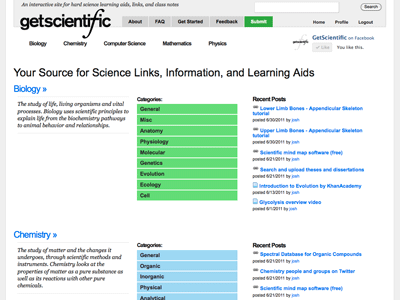
We set out to build “an online database of learning aids, resources, links, and guides for students and professors of hard sciences” based on our experience trying to find useful resources online during our stint as undergraduate chemistry students.
Older
Mar 15, 2011
Web Literacy for Business Owners
This is a pool of topics that I consider essential for business owners to understand, the collection of which define basic web literacy for business owners.